


🔒 Monthly and Annual Member Exclusive
⚗️ Basic Science Concepts: The pH Scale
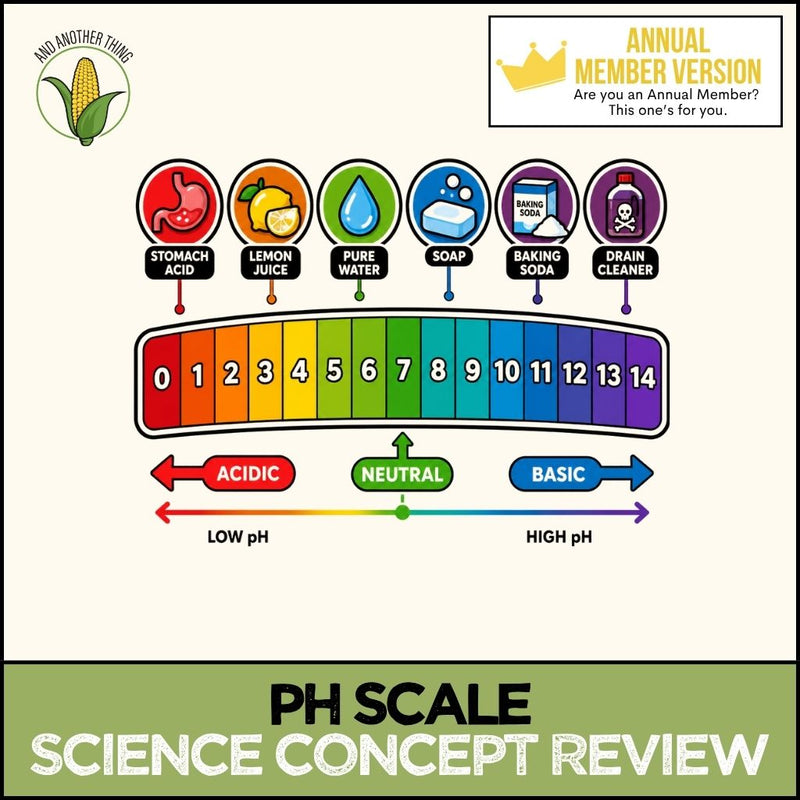
Every liquid has a chemistry to it, from pond water to milk to soil moisture, and the pH scale is how scientists measure exactly how acidic or basic that liquid is. This packet teaches students what pH means, how it is measured, and why farmers, ranchers, and food producers track it closely in soil, water, and food production.
Students learn what hydrogen and hydroxide ions are, how the 0 to 14 scale works, and why it is logarithmic, meaning each whole number represents a tenfold change in acidity rather than a simple step. The packet also covers the difference between acids and bases, how neutralization works, and the three common ways pH is measured, from litmus paper to digital pH meters. Real applications include how soil pH affects nutrient availability for crops, how water pH impacts livestock and fish health, and how pH controls fermentation in foods like silage and cheese.
A great tie-in for: chemistry, biology, environmental science, and agricultural science units.
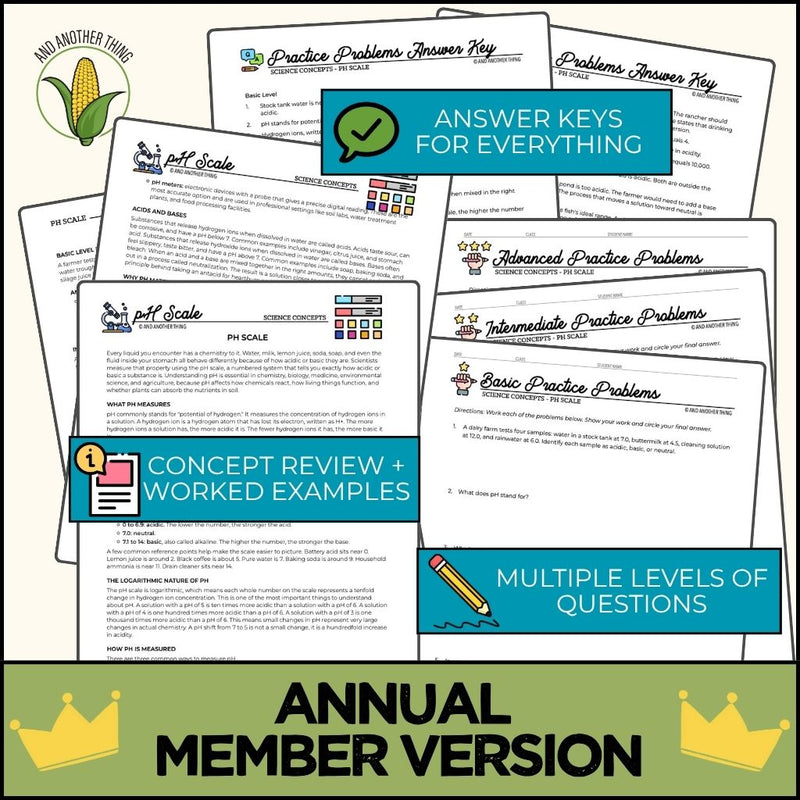
These work as a stand-alone lesson on a specific science concept, a review activity before a unit test, or a substitute lesson that still teaches something real. Students get a full walk-through of the concept, worked examples at increasing difficulty, and enough practice to actually use it, not just read about it.
📁 What's Included:
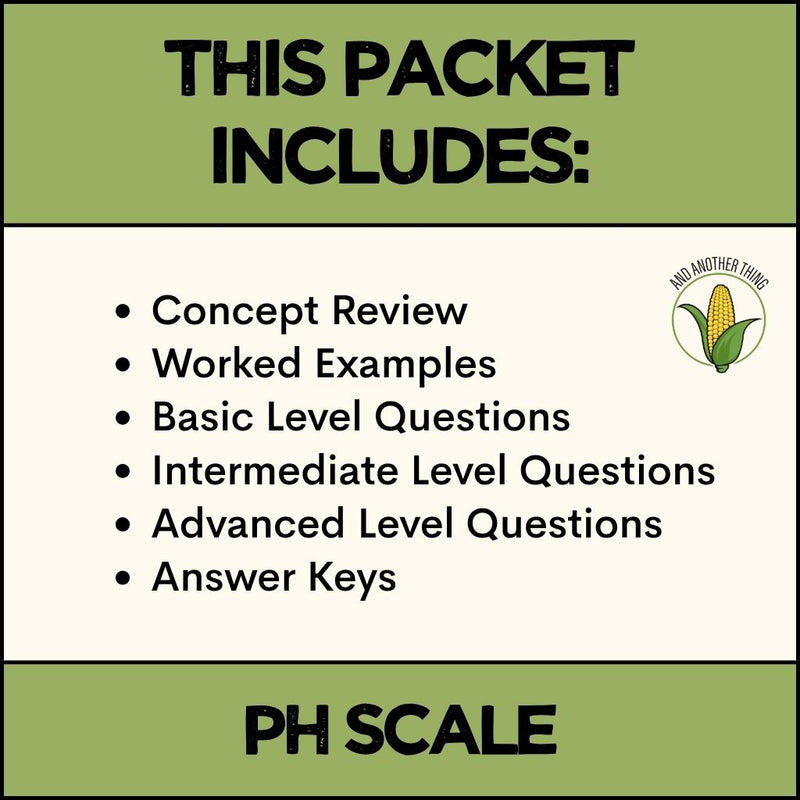
- Concept Page: a full explanation of the scientific method's eight steps, the three types of variables, how to write a strong if/then hypothesis, and key practices like changing only one variable and using a large enough sample size
- Worked Examples: basic, intermediate, and advanced level examples showing the concept applied to real agricultural scenarios, from seed germination to a multi-season crop study
- Practice Problems: 25 problems across basic, intermediate, and advanced levels, covering identifying variables, writing hypotheses, analyzing data, and evaluating conclusions
- Answer Key: complete worked solutions and explanations for every practice problem
Our shipping is based on total order amount. Shipping will be automatically calculated when shopping online. (There is no shipping charged on digital download products. I mean who would do that really?)
We ship by UPS. You will receive a tracking number when your order ships.
If you are completing a School Purchase Order or if you just want to estimate your total expenses use the following information:
- For order totals $100 and under ---- add $15
- For order totals $101 to $340 ---- add $20
- Order totals over $350 ---- add $30
- Make sure to provide a physical address...UPS will NOT deliver to a Post Office box. We tried. Then we received a firm talking to and we had to go to bed without dinner. Please don't make us try that again.
🔒 Monthly and Annual Member Exclusive
⚗️ Basic Science Concepts: The pH Scale
Every liquid has a chemistry to it, from pond water to milk to soil moisture, and the pH scale is how scientists measure exactly how acidic or basic that liquid is. This packet teaches students what pH means, how it is measured, and why farmers, ranchers, and food producers track it closely in soil, water, and food production.
Students learn what hydrogen and hydroxide ions are, how the 0 to 14 scale works, and why it is logarithmic, meaning each whole number represents a tenfold change in acidity rather than a simple step. The packet also covers the difference between acids and bases, how neutralization works, and the three common ways pH is measured, from litmus paper to digital pH meters. Real applications include how soil pH affects nutrient availability for crops, how water pH impacts livestock and fish health, and how pH controls fermentation in foods like silage and cheese.
A great tie-in for: chemistry, biology, environmental science, and agricultural science units.
These work as a stand-alone lesson on a specific science concept, a review activity before a unit test, or a substitute lesson that still teaches something real. Students get a full walk-through of the concept, worked examples at increasing difficulty, and enough practice to actually use it, not just read about it.
📁 What's Included:
- Concept Page: a full explanation of the scientific method's eight steps, the three types of variables, how to write a strong if/then hypothesis, and key practices like changing only one variable and using a large enough sample size
- Worked Examples: basic, intermediate, and advanced level examples showing the concept applied to real agricultural scenarios, from seed germination to a multi-season crop study
- Practice Problems: 25 problems across basic, intermediate, and advanced levels, covering identifying variables, writing hypotheses, analyzing data, and evaluating conclusions
- Answer Key: complete worked solutions and explanations for every practice problem
Our shipping is based on total order amount. Shipping will be automatically calculated when shopping online. (There is no shipping charged on digital download products. I mean who would do that really?)
We ship by UPS. You will receive a tracking number when your order ships.
If you are completing a School Purchase Order or if you just want to estimate your total expenses use the following information:
- For order totals $100 and under ---- add $15
- For order totals $101 to $340 ---- add $20
- Order totals over $350 ---- add $30
- Make sure to provide a physical address...UPS will NOT deliver to a Post Office box. We tried. Then we received a firm talking to and we had to go to bed without dinner. Please don't make us try that again.